Facebook
 Instagram
 Twitter
 Youtube
HISTORY OF PARA POWERLIFTING
Powerlifting is one of the Paralympic Movement’s fastest growing sports in terms of participants and is now practiced in nearly 100 countries.
The sport represents the ultimate test of upper body strength with athletes competing in the bench press discipline.
Competitors must lower the bar to their chest, hold it motionless on the chest and then press it upwards to arms-length with locked elbows. Athletes are given three attempts and the winner is the athlete who lifts the highest number of kilograms.
Such is the strength of athletes competing in this sport, that it is not uncommon to see a competitor lift more than three times their own body weight.
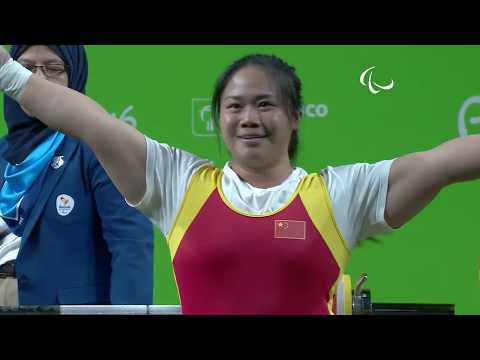
World Para Powerlifting, under the governance of the International Paralympic Committee, acts as the international federation for the sport and is based in Bonn, Germany.
Open to male and female athletes with eight eligible physical impairments, athletes compete in one sport class across 10 different weight categories per gender.
Major competitions include the Paralympic Games which take place every four years, biennial World Championships, triennial regional Championships and annual World Cup and Grand Prix events.
Competition description
• Men compete in the 49kg, 54kg, 59kg, 65kg, 72kg, 80kg, 88kg, 97kg, 107kg and +107kg divisions.
• Women compete in the 41kg, 45kg, 50kg, 55kg, 61kg, 67kg, 73kg, 79kg, 86kg and +86kg divisions.

In powerlifting, male and female athletes assume a supine position on a specially designed bench, and after taking or receiving the bar at arms-length, the lifter shall wait with locked elbows and the bar under control for the Chief Referee's signal.
After receiving the signal "start", the lifter must lower the bar to the chest, hold it motionless (visible) on the chest and then press it upwards evenly, with an even equal extension of both the arms with locked elbows.
When held motionless and controlled in this position, the audible signal "rack" shall be given and the bar is returned to the rack.
Then an immediate decision shall be given by the three nominated international referees through a system of white and red lights. Two or more white lights signify a good lift and two or more red lifts reflect a no lift.
Each athlete has three attempts, and upon discretion of the jury a fourth attempt may be allowed to achieve a new world record, but this attempt does not count towards the final competition result.
SPORT EQUIPMENT
Athletes compete lying on an official World Para Powerlifting approved bench which is 2.1m long. The width of the bench is 61cm wide and narrows to 30cm where the head is placed.
The height of the bench varies between 48 and 50cm from the ground. World Para Powerlifting approved discs must conform to several standards outlined in the sport’s rules and regulations.
PARALYMPIC HISTORY
Although weightlifting made its Paralympic debut at Tokyo 1964, it was not until the 1984 Games that powerlifting was first included as a Paralympic sport.
Initially the sport of weightlifting only catered for male athletes with a spinal cord injury, but in the years that followed the sport began to include other impairment groups too.
GROWTH OF WEIGHTLIFTING AT THE PARALYMPIC GAMES
| Year | Countries | Medal events | Male | Female | Total |
|---|---|---|---|---|---|
| 1964 | 10 | 4 | 18 | 0 | 18 |
| 1968 | 13 | 4 | 28 | 0 | 28 |
| 1972 | 18 | 6 | 46 | 0 | 46 |
| 1976 | 16 | 6 | 43 | 0 | 43 |
| 1980 | 18 | 11 | 58 | 0 | 58 |
Weightlifting featured athletes performing a dead bench press, whereby the lift starts from the chest. Powerlifting on the other hand involves athletes receiving the bar at arms-length, lowering it to their chest until it is motionless, before pressing it back upwards evenly.

At the 1984 Paralympics, the powerlifting competition took place in New York, USA, and featured 16 male athletes from six countries. Since its Paralympic debut the sport has been included in every edition of the Games.
In 1991 it was decided that following the Barcelona 1992 Paralympics only powerlifting would be included in the Games programme with weightlifting no longer featuring. The result was a dramatic increase in the number of participating countries, from 25 in Barcelona to 58 at the Atlanta 1996 Games.
By Sydney 2000, the year women were first allowed to compete in Paralympic powerlifting, the sport was widely practised in all five continents.

Ⓒ Getty Images for the IPC
At the Rio 2016 Paralympic Games, where 180 athletes competed in 20 medal events, history was made when Siamand Rahman became the first Paralympian to lift over 300kg. The Iranian eventually lifted 310kg, equivalent to two baby elephants!
The first World Championships under the governance of World Para Powerlifting was held in Uppsala, Sweden, in 1994 and catered for 137 men and women. The event was then held every four years until 2014, with both Dubai, UAE, and Kuala Lumpur, Malaysia, hosting the Championships on two occasions.
The 2017 World Championships were held in Mexico City and marked the start of a new cycle whereby the event is held every two years. The Mexican capital also hosted the first World Junior Championships.
GROWTH OF POWERLIFTING AT THE PARALYMPIC GAMES
| Year | Countries | Medal events | Male | Female | Total |
|---|---|---|---|---|---|
| 1984 | 6 | 7 | 16 | 0 | 16 |
| 1988 | 16 | 9 | 52 | 0 | 52 |
| 1992 | 25 | 10 | 106 | 0 | 106 |
| 1996 | 56 | 10 | 141 | 0 | 141 |
| 2000 | 67 | 20 | 166 | 92 | 257 |
| 2004 | 69 | 20 | 150 | 79 | 229 |
| 2008 | 74 | 20 | 121 | 82 | 203 |
| 2012 | 61 | 20 | 113 | 80 | 193 |
| 2016 | 60 | 20 | 100 | 80 | 180 |
| 2020 | 54 | 20 | 90 | 78 | 178 |
OVERALL PARALYMPIC POWERLIFTING MEDALS TABLE
| RANK | COUNTRY | GOLD | SILVER | BRONZE | TOTAL |
|---|---|---|---|---|---|
| 1 | China | 34 | 27 | 22 | 83 |
| 2 | Nigeria | 24 | 16 | 14 | 54 |
| 3 | Egypt | 22 | 32 | 21 | 75 |
| 4 | Iran | 12 | 10 | 10 | 32 |
| 5 | South Korea | 7 | 8 | 5 | 20 |
TOP 5 MALE PARALYMPIC MEDALLISTS
| RANK | ATHLETE | YEARS COMPETING | GOLD | SILVER | BRONZE | TOTAL |
|---|---|---|---|---|---|---|
| 1 | Haidong Zhang (CHN) | 1996-2008 | 4 | 0 | 0 | 4 |
| 1= | Lei Liu (CHN) | 2008-2020 | 4 | 0 | 0 | 4 |
| 3= | Gomma G. Ahmed (EGY) | 1992-2004 | 3 | 1 | 0 | 4 |
| 3= | Sherif Osman (EGY) | 2008-present | 3 | 1 | 0 | 4 |
| 5 | Bernd Vogel (GER) | 1992-2000 | 3 | 0 | 0 | 3 |
TOP 5 FEMALE PARALYMPIC MEDALLISTS
| RANK | ATHLETE | YEARS COMPETING | GOLD | SILVER | BRONZE | TOTAL |
|---|---|---|---|---|---|---|
| 1 | Fatma Omar (EGY) | 2000-present | 4 | 2 | 0 | 6 |
| 1= | Amalia Perez (MEX) | 2000-present | 4 | 2 | 0 | 6 |
| 3 | Taoying Fu (CHN) | 2000-2012 | 4 | 0 | 0 | 4 |
| 4 | Lucy Ejike (NGR) | 2000-present | 3 | 2 | 1 | 6 |
| 5 | Lidiia Soloviova (UKR) | 2000-present | 3 | 1 | 1 | 5 |